Combination Forecast vs Reverse Forecast: The Difference Most UK Slips Get Wrong
 Available in US
Table of Contents
- The two-word distinction that costs punters money
- What a straight forecast actually does
- Reverse forecast u2014 two lines, both orderings of two horses
- Combination forecast u2014 the perm that scales with selections
- A worked comparison on the same three horses
- Where Tote Plus changes the comparison
- The slip discipline that prevents the most common mistakes
The two-word distinction that costs punters money
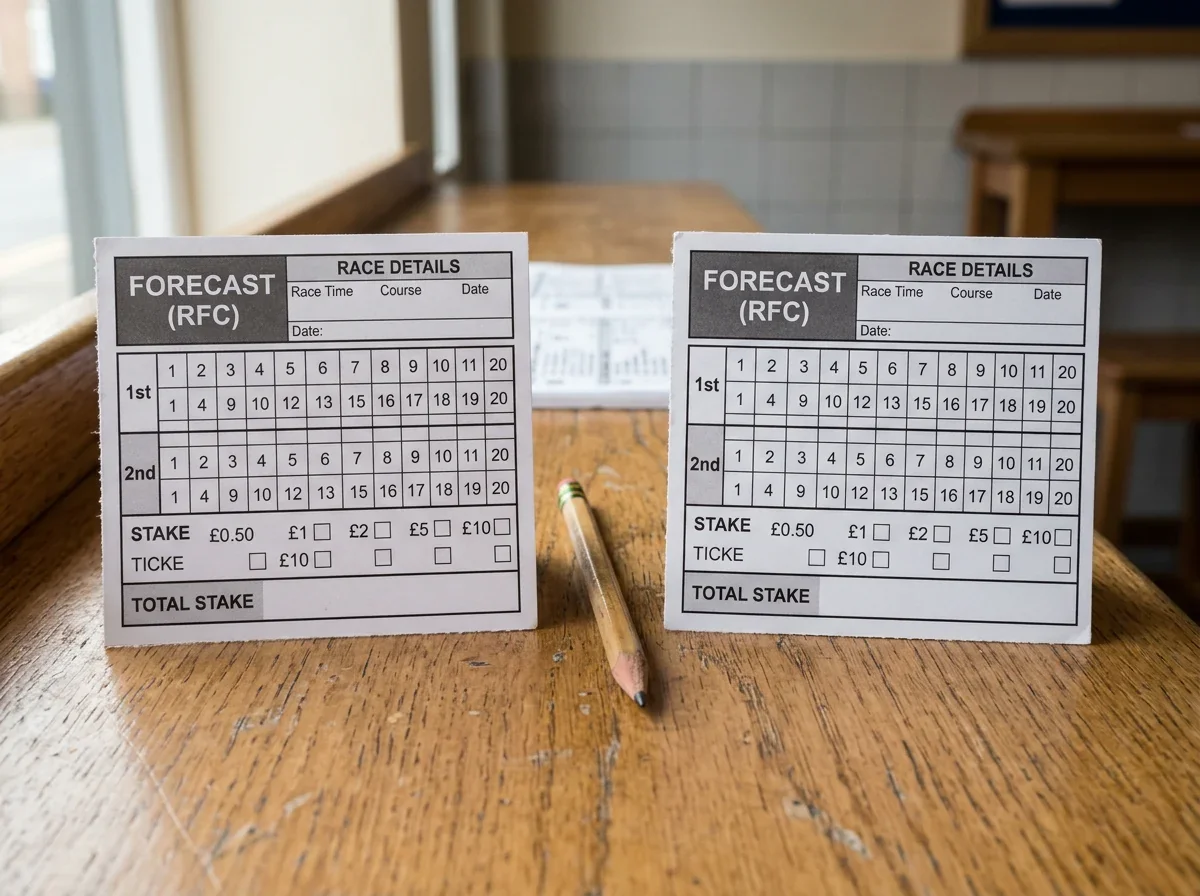
A cashier at a Doncaster shop told me once that the most common dispute she’d handled in a year wasn’t about non-runners or settlement errors. It was about punters who’d written “forecast” on a slip when they meant “reverse forecast,” or “reverse” when they meant “combination.” Two words, separated by maybe ten letters across the two product names, and the structural difference at staking and settlement is significant enough to produce regular complaints. This article is about getting those two words straight.
The confusion is understandable. Both products cover two horses across the first two positions. Both use the CSF or Tote Exacta as the underlying dividend mechanism. Both are common picks on Saturday slips. The difference is what each product actually covers, what each costs at a given unit stake, and which is structurally correct for what you’re trying to back. Once the distinction is clear, the slip stops costing more than it should and the dividend collection runs more cleanly.
What a straight forecast actually does
A straight forecast is the simplest of all forecast products. You name two horses, you name an order (horse A wins, horse B finishes second), and the bet wins only if that exact order lands. The line count is one. The cost is one unit stake, full stop. Settlement is the CSF dividend on the correct A-B order u2014 or zero, if A and B don’t finish in that order.
The straight forecast is the appropriate product when the punter has a high-conviction view on the order of finish. If you think horse A is significantly more likely to win than horse B and you’re confident horse B will be second behind A specifically (rather than ahead of A or behind a third horse), the straight forecast captures that conviction with maximum efficiency. One line, one outlay, full CSF dividend on settlement.
The practical use case is narrow. Most punters who place a forecast aren’t certain enough about the order to justify a straight bet u2014 they think horses A and B are the two most likely to fill the placings but don’t have strong views on which finishes ahead of the other. For those situations, the reverse forecast or combination forecast are structurally more appropriate.
Reverse forecast u2014 two lines, both orderings of two horses
A reverse forecast on horses A and B covers two orderings: A-B and B-A. The bet wins if A and B fill the first two positions in either order. The line count is two. The cost is two unit stakes. The settlement is the CSF dividend on whichever order actually lands u2014 you collect one of the two lines, the other settles at zero.
This is the most common forecast product for casual punters and it’s structurally the right choice when you’ve narrowed the race to two specific horses and don’t care which finishes first. A 7/2 favourite and a 6/1 second-favourite paired in a reverse forecast on a contested handicap is the textbook example u2014 you back the placings, you don’t predict the order, and the CSF settles whichever order materialises.
The cost is straightforward at any unit stake. A £1 reverse forecast on two horses costs £2. A £5 reverse forecast costs £10. The arithmetic doesn’t change regardless of the horses’ SPs or the race’s field size. The simplicity is one of the reasons the reverse forecast is the entry-level exotic for most UK punters.
Combination forecast u2014 the perm that scales with selections
A combination forecast covers all orderings of more than two horses across the first two positions. Three horses produce 3u00d72 = 6 lines. Four horses produce 12 lines. Five horses produce 20 lines. Six horses produce 30 lines. Each line is an ordered pair (A-B, B-A, A-C, C-A, B-C, C-B for a three-horse combination forecast). The bet wins on whichever single line matches the actual 1-2 order; the other lines settle at zero.
The combination forecast is structurally the right product when the punter has a shortlist of three or more genuine contenders and wants coverage across any plausible 1-2. The reverse forecast is a degenerate case of the combination forecast for two horses u2014 mathematically identical, just named differently. Some operators use “combination forecast” to mean any combination forecast including the two-horse case (which is the reverse forecast in another name), while others reserve the term for three-or-more selections.
The cost arithmetic mirrors the box forecast in every respect. A £1 combination forecast on four horses produces 12 lines at £1 = £12 outlay. A 50p combination forecast on five horses produces 20 lines at 50p = £10. A 10p combination forecast on six horses produces 30 lines at 10p = £3. The minimum unit stake at most UK operators online is 10p per line, the same as for all other box products.
A worked comparison on the same three horses
Take three horses: A at 4/1, B at 8/1, C at 14/1. Imagine the result is C-A in correct order u2014 the 14/1 horse wins, the 4/1 favourite is second.
A straight forecast of A-B at £1 returns zero u2014 wrong winner. A straight forecast of C-A at £1 would return the CSF dividend on that pair, which on this kind of pair structure typically lands in the £80 to £120 range on a 12 to 14-runner handicap.
A reverse forecast of A and C at £1 (two lines, £2 outlay) returns the CSF dividend on the C-A order on one of the two lines, with the A-C line settling at zero. Net return: same £80-£120 dividend, less the £2 outlay.
A combination forecast of A, B and C at £1 (six lines, £6 outlay) returns the CSF dividend on C-A on that one line, with the other five lines (A-B, A-C, B-A, B-C, C-B) all settling at zero. Net return: same £80-£120 dividend, less the £6 outlay.
The straight forecast is the cheapest if you correctly predict the order. The reverse forecast is the cheapest if you know the placed pair but not the order. The combination forecast is the appropriate product if you have a shortlist of three. Across the long run, the right product is the one matched to the conviction level on each race u2014 not the cheapest possible cost.
Where Tote Plus changes the comparison
The CSF-versus-Tote question runs through every forecast product. Tote Plus Exacta beats the equivalent CSF in 77% of cases with an average +21% value per bet. That structural advantage applies across straight, reverse and combination forecasts uniformly u2014 the underlying pair-of-horses settlement is the same product, just routed through the pool with the guarantee that the dividend never falls below the CSF.
For most boxing punters most of the time, defaulting to Tote Plus on combination forecasts adds 21% to the long-run dividend collection without any additional skill or judgement required. The product picks the higher of pool or CSF automatically. The structural ROI uplift over a season of routine combination forecast betting is substantial when compounded across hundreds of slips.
The exception sits on contested Festival days where the standard Tote pool dynamics produce extreme outlier dividends that the smaller Tote Plus pool sometimes can’t match u2014 the Royal Ascot 2024 Coventry Stakes Tote Trifecta of £122,667 against the CST of £83,273 is the headline example. Tote Plus would have paid £122,667 there because the pool exceeded the CST, but on rare Festival days the standard Tote can briefly exceed even Tote Plus’s larger figure when the casual money concentrates extremely heavily on losing tickets.
The slip discipline that prevents the most common mistakes
The discipline that eliminates the cashier-counter complaints I described at the start is straightforward. Read the slip back before submitting. Confirm the product name written matches what the staking arithmetic implies. If you’ve written “forecast” with two horse names and a £2 stake, you’re paying for a reverse forecast u2014 a straight forecast at £2 would have £2 outlay on one line, not two lines totalling £2. The arithmetic should reconcile.
Online slips reduce this risk because the product type is explicitly named and the line count and total outlay display before submission. Most racecourse betting shop slips still rely on the cashier reading the punter’s intent from the written text. Five seconds of verification at the counter prevents the disputes that fill betting-shop staff training sessions.
For perms of four horses and above where the cost arithmetic matters more, the full breakdown is in this calculator covering every common UK box permutation cost from three to eight horses at standard unit stakes. The reverse-combination distinction collapses into the broader cost grid at four horses and above.
Is a reverse forecast the same as a £1 box forecast on two horses?
Functionally yes. A reverse forecast on two horses covers both orderings (A-B and B-A) for two unit stakes total u2014 identical to a box forecast on the same two horses at the same unit. Different operators use different naming conventions, but the line count and dividend mechanics are the same.
Why would anyone bet a straight forecast over a reverse forecast?
To save half the stake when they have a high-conviction view on the order. If you genuinely believe horse A is significantly more likely to beat horse B than vice versa, a straight forecast on A-B at £2 captures the same CSF dividend as the reverse forecast on the same pair at £2, but with the structural benefit of placing the bet at a single line rather than splitting across two.
Created by the ”box bet in Horse Racing” editorial team.