Bankroll Management for Combination Forecasts: Stake Scaling
 Available in US
Table of Contents
Stop-Loss Strategies to Prevent Silent Bankroll Drain
Most punters who lose serious money on combination forecasts don’t lose it on one disastrous slip. They lose it over six months of £20 perms, £40 trifectas, £60 weekend bets, week after week, with no underlying staking framework. The damage compounds gradually. The bankroll thins. The slips get bigger to chase what’s already gone. By the end of the National Hunt season, the money is gone and the punter can’t really say where it went.
Boxing demands a tougher staking discipline than straight betting because the lines compound multiplicatively. A £1 unit on a five-horse box tricast is a £60 bet, not a £5 bet. Without a framework that respects that arithmetic, every Festival week is a structural threat to the season’s bankroll. The framework I run myself isn’t complicated – £50 a week, divided systematically across days and product types – but it survived the 2024-25 jumps season intact when many other approaches didn’t.
The weekly £50 – how to split it across days and products
A £50 weekly budget on combination forecasts is a sensible starting framework for a serious recreational punter. The first decision is how to allocate that £50 across the seven days of the week. The instinct of most punters is to dump the lot on Saturday’s feature card. That instinct is wrong on average – Saturday cards are where casual money is heaviest and the pool dilution effect runs hardest against perm punters.
My split runs roughly £15 on Tuesday or Wednesday cards (contested handicap meetings where the pool dilution is lower), £10 on Thursday evening or Friday daytime if a strong contested handicap appears, £20 on the Saturday with the bulk targeted at one specific race rather than spread, and £5 as a contingency for an unexpected midweek opportunity. The 10p minimum line stake at most UK operators online makes small-budget perms genuinely workable – a 10p box tricast on four horses costs £2.40, leaving room for multiple bets within a daily budget.
The product split matters as much as the day split. Within a £20 Saturday allocation, splitting between a £12 combination forecast on a five-horse shortlist (£12 buys 24 lines at 50p) and an £8 combination tricast on a four-horse shortlist (£8 buys 24 lines at 33p – rounded to whole-penny line stakes by the operator) provides exposure to both the forecast and tricast dividends on the same kind of race profile, without committing the full £20 to either product alone.
The festival ring-fence – why Cheltenham needs separate accounting
Cheltenham week breaks any normal weekly framework. £450 million wagered across four days, as William Hill projected for the 2026 Festival. 68.8 million bets recorded across UK operators during Cheltenham 2025, according to Optimove Insights. Daily active player counts running 178 to 189% above baseline. The casual money flood that comes with the Festival creates pool conditions you don’t see on any other week of the calendar.
The discipline I apply is to ring-fence Festival weeks completely. A separate Festival bankroll, distinct from the regular £50 weekly budget, set aside in the months leading up to the meeting. £200 to £400 is typical for the four days, depending on the punter’s circumstances. Cheltenham, Grand National week, and Royal Ascot all sit in this ring-fenced category – same logic, same separate accounting.
The reason for the separation is psychological as much as financial. A Festival week with the regular weekly budget creates pressure to win across the calendar’s most uncertain events, and that pressure leads to chasing – bigger perms on Wednesday after a losing Tuesday, abandoning the staking framework by Friday because “this is when it has to land.” A ring-fenced Festival budget removes that pressure. When the £400 is gone, it’s gone, and the regular weekly framework picks up the following Monday without interruption.
Stop-loss triggers – when to step out for a week
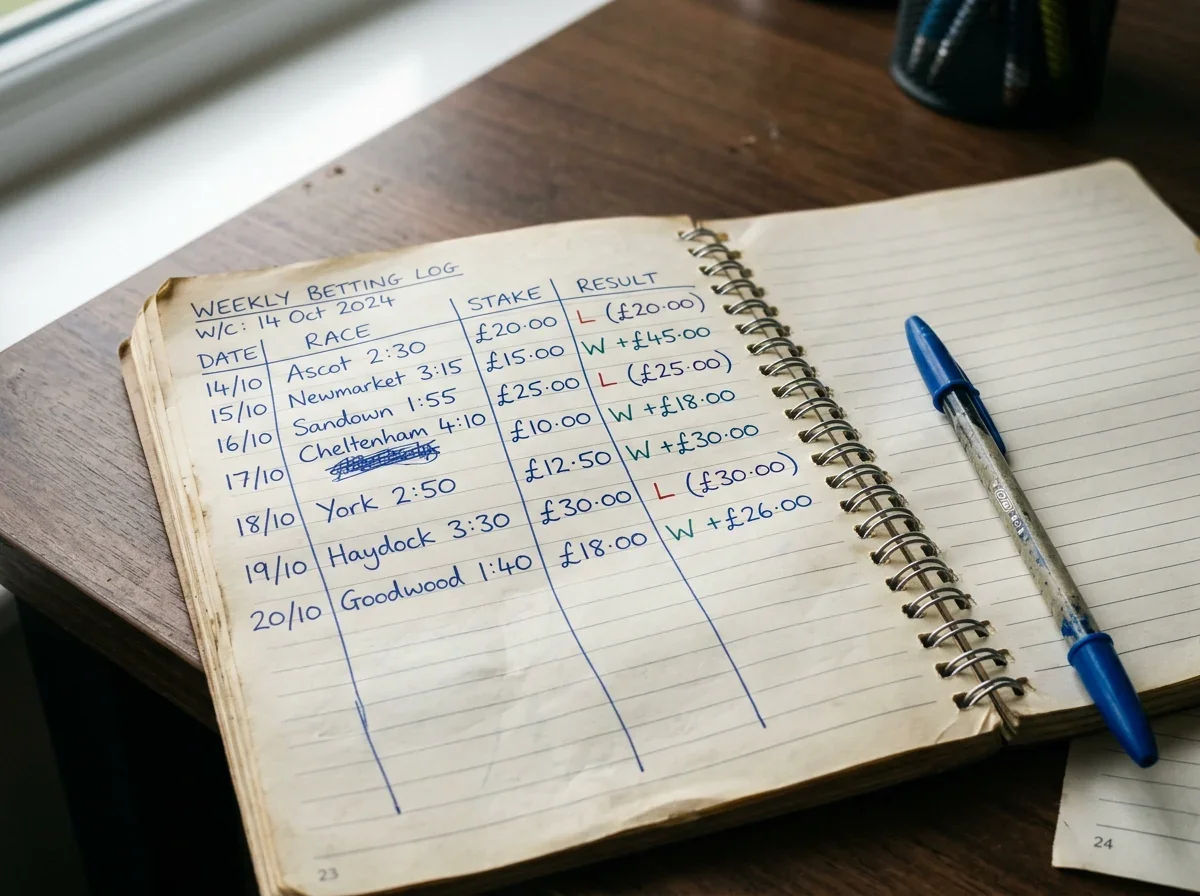
The stop-loss is the part of any staking framework most punters skip. They have a budget. They don’t have a rule for when to stop using it. The result is the slow-grind erosion of bankroll across losing streaks that should have prompted a pause.
My stop-loss runs on two triggers. The first is a flat number: four consecutive losing weeks on the regular £50 budget triggers a one-week break, regardless of how strong the upcoming card looks. The second is a drawdown number: 20% of the rolling 12-week bankroll lost in any single week triggers a one-week break, even if the four-week streak hasn’t kicked in. Both triggers are conservative. Both have saved me from bigger drawdowns more than once.
The Levy Board’s data on overall industry turnover – falling 9% year-on-year in Q1 2025 and 12.8% on a longer view to 2023, per BHA Racing Reports – reflects a broader environment where the recreational punter pool is shrinking. That structural backdrop matters because pool dividends depend on aggregate participation. Stop-loss discipline isn’t just personal hygiene – it’s recognition that the conditions the strategy was built for can shift, and stepping out lets you reassess whether the framework still fits the environment.
The scale-up criteria – when to move from £50 to £75 or £100
The opposite question is when to increase the weekly budget rather than reduce it. The instinct of every winning punter is to scale faster than the data supports. A good month becomes evidence to double the stakes, and the underlying variance hasn’t been tested across enough samples to know whether the good month was edge or noise.
The criteria I apply for scaling are tight. A trailing 24-week rolling P&L positive by at least 15% of the deployed bankroll, with no single month accounting for more than 50% of the gain (testing whether the edge is sustained or front-loaded), with at least 60% of weeks within the period either neutral or positive. Hit those three filters across 24 weeks and a 50% scaling – moving from £50 to £75 weekly – is justifiable.
The scaling-down criteria are looser and trigger faster. Two consecutive months negative below the 24-week starting bankroll triggers a reduction back to the original level. That asymmetry – slow to scale up, fast to scale down – is the structural protection against the variance that comes with exotic betting. The 77% beat rate of Tote+ Trifecta over CST is a long-run edge, but a six-month sample isn’t long-run, and behaving as if it is breaks bankrolls.
For a worked example of how a structured budget plays out across a single race day with specific selections, the £20 Newmarket handicap walk-through demonstrates the bankroll mechanics applied to a real race profile.
Should I stake more on festival weeks if my regular bankroll is unchanged?
Only if you have a ring-fenced Festival budget separate from your regular weekly funds. The casual money inflow on Festival days genuinely creates structural opportunity, but it also creates pressure that breaks normal staking discipline. The ring-fenced approach captures the opportunity without putting the regular bankroll at risk.
Is flat-staking better than Kelly for combination forecasts?
For most punters on combination forecasts, yes. Kelly assumes accurate probability estimates, and exotic forecast probability estimation is genuinely difficult. Flat staking – fixed unit per perm with line stakes determined by the perm size – sacrifices some theoretical efficiency for substantial protection against estimation error, which is the bigger risk on combination products.
Prepared by the box bet in Horse Racing editorial staff.