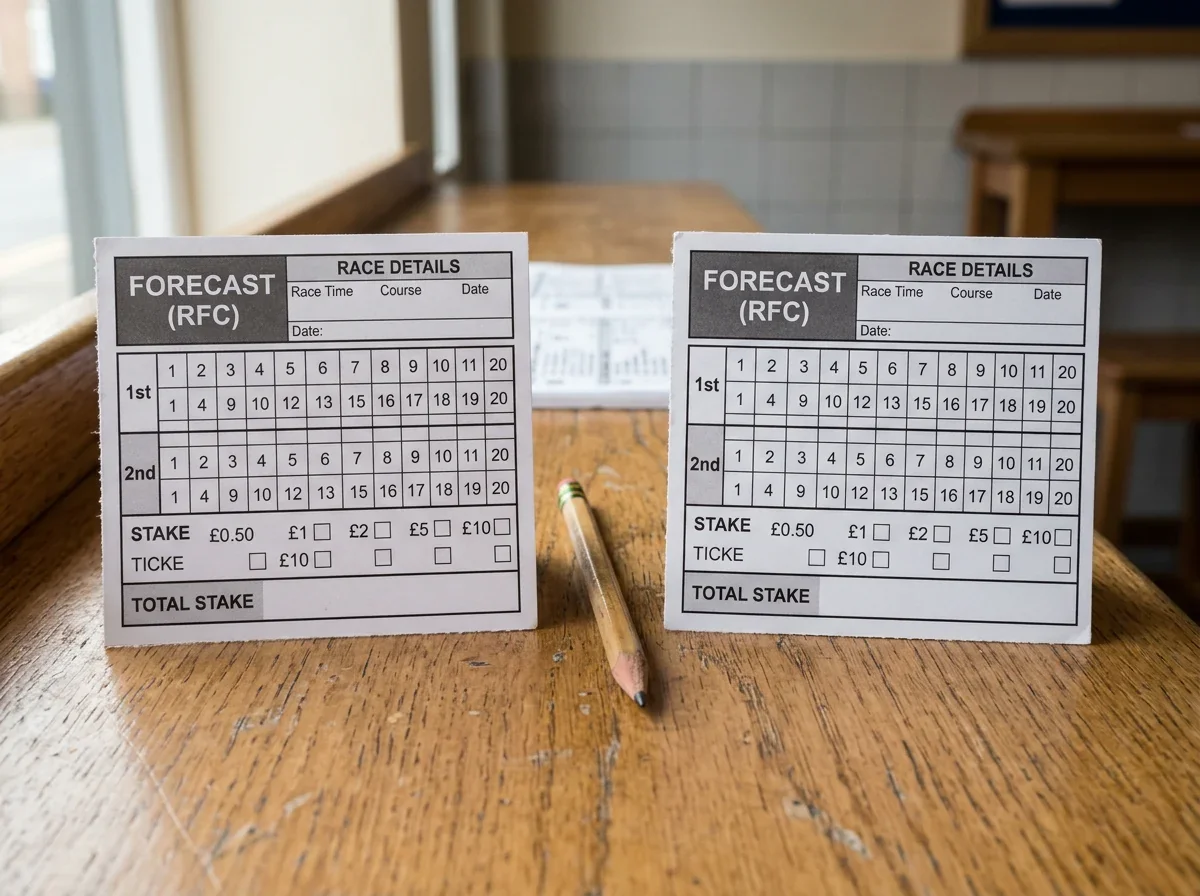
Worked Example: A £20 Box Tricast on a Newmarket Handicap Walked Through Line by Line
 Available in US

The bet I’d actually place on a typical July Saturday
People ask me regularly to show what a real box-tricast slip looks like end to end. Not a hypothetical. Not a perfect-result example designed to justify the strategy. A genuine bet on a genuine race with the same constraints any reader would face. So here it is. A £20 box tricast on a contested Newmarket handicap, walked through from race selection to settlement, with the same arithmetic and decisions I’d apply on a regular Saturday card.
The race we’ll use as the worked example is a hypothetical 14-runner July Cup-day handicap on the July course, six furlongs, with a competitive top of the market and several genuine longshots. The exact prices and result are illustrative, but they’re calibrated to match what a typical Newmarket Saturday handicap actually produces. Premier Flat meetings averaged 11.02 runners per race in BHA’s Q3 2025 reporting period u2014 14 runners on a Newmarket Saturday handicap is at the upper end of typical, which is the sweet spot for a serious perm.
Shortlisting from 14 runners down to four
Before any line goes on a slip, the shortlist matters more than the perm structure. Out of 14 runners, I’d typically work down to four genuine contenders through a sequence of structural filters: form on similar going, recent finishing positions in handicaps of comparable grade, jockey-trainer combinations with strong recent course strike rates, and weight comparison against last winning effort.
The four-horse shortlist for this worked example breaks down as follows. Horse A is the 9/2 favourite with two strong runs on similar ground and a top jockey. Horse B is a 7/1 contender drawn well with course form from the previous season. Horse C is a 14/1 outsider whose recent form has been on softer ground but who’s drawn ideally for a strong-pace handicap. Horse D is a 25/1 longshot with one eye-catching effort three runs back when staying on through beaten horses u2014 the kind of profile that gets boxing punters’ attention precisely because the market doesn’t.
The shortlist could easily be three horses or five. Three would lower the line count and improve coverage per pound, but reduce upside if a 25/1 result lands. Five would push the cost up significantly and dilute conviction. Four sits at the discipline boundary I keep returning to u2014 broad enough to cover plausible outcomes, narrow enough that every selection is genuinely on the shortlist for a reason.
The line count and unit stake calculation
A box tricast on four horses produces nu00d7(n-1)u00d7(n-2) = 4u00d73u00d72 = 24 permutations. Each permutation is a separate CST line at whatever unit stake we set. The total outlay is unit stake u00d7 24.
For a £20 budget, the natural unit stakes are 50p or £1. A £1 unit produces total outlay £24 u2014 marginally over budget. A 50p unit produces total outlay £12 u2014 well under budget. The middle option of 80p per line would produce £19.20 total, but 80p line stakes aren’t supported as standard units at most UK operators. The realistic choice is 50p at £12 outlay or £1 at £24 outlay.
For this worked example I’d go with the £1 unit at £24 outlay, accepting a 20% over-budget for the cleaner dividend collection on a winning line. The marginal £4 over the £20 budget delivers significantly higher dividends on settlement u2014 a £1 winning CST line collects the published dividend in full, where a 50p winning line collects half that figure. The discipline of staying on round-pound units pays off on every collected slip across the long run.
What the slip actually covers
The 24 lines on a four-horse box tricast cover every possible ordering of three of the four horses across positions one, two and three. Listed out:
A-B-C, A-B-D, A-C-B, A-C-D, A-D-B, A-D-C. That’s six lines starting with A. The same pattern repeats starting with B (B-A-C, B-A-D, B-C-A, B-C-D, B-D-A, B-D-C), with C (C-A-B, C-A-D, C-B-A, C-B-D, C-D-A, C-D-B), and with D (D-A-B, D-A-C, D-B-A, D-B-C, D-C-A, D-C-B). Total 24 lines.
Only one of those 24 lines can settle as a winner u2014 the line that exactly matches the actual finishing order of three of the four selections. The other 23 lines settle as losers regardless of how close the result came to landing them. That’s the structural cost of boxing: paying for full coverage of the orderings in exchange for the certainty that any 1-2-3 from your shortlist will land the bet.
Settlement scenarios for the worked example
Now suppose the race runs and the result is C, A, D u2014 the 14/1 horse winning, the 9/2 favourite second, the 25/1 third. The matching line on our slip is C-A-D. That line collects the CST dividend on the 14/1-9/2-25/1 combination.
The CST formula for this kind of result would typically produce a dividend in the £800 to £1,400 range on a £1 stake, depending on the field size and the exact prices of the un-selected horses. Let’s call it £1,100 for this worked example, which is consistent with what the algorithm tends to return for a mid-priced winner with a favourite-second and a longshot-third on a 14-runner handicap.
So the £24 outlay returns £1,100 on the winning line, with the other 23 lines settling at zero. Net return: £1,100 u2212 £24 = £1,076. The same result through a Tote Trifecta would depend on the pool size. On a Newmarket Saturday handicap with strong casual participation, the pool dividend on this kind of result could be £1,400 to £2,000 per £1 unit. Tote+ Trifecta would automatically pay the higher of the two u2014 the pool figure u2014 demonstrating the structural advantage that the +50% average uplift on Tote+ over CST captures across the calendar.
The losing scenarios I plan around in advance
Most weeks, the bet doesn’t land. The four-horse shortlist might cover the placings in the wrong combination u2014 a fifth horse outside the shortlist finishing second or third, breaking the line. Or the favourite might win in a result where the second and third aren’t on the shortlist. Or two of the shortlist might place but the third placed runner is outside it.
The structural reality is that a four-horse box tricast on a 14-runner handicap has approximately a 5 to 10% strike rate over time, varying with how well the shortlist matches the actual outcomes. Most weeks are losses. The bet justifies itself over time because the dividends on winning weeks dwarf the cumulative losses on losing weeks u2014 a £1,076 net return on a winning slip covers many £24 losing slips, with positive long-run expectancy if the shortlist quality is genuinely good.
The disciplined approach is to budget annually rather than weekly. Twenty pounds a week across 50 weeks is a £1,000 annual budget. A single £1,076 winning week recoups the entire year’s outlay. A second winning week in the year delivers net profit. The arithmetic works only if the shortlists are genuinely better than random, which is the whole subject of how to identify those races and selections to begin with. The guide to selecting the right UK races for box bets sits behind every aspect of the worked example above and is the foundation any boxing punter needs.
Why not use a 50p unit to keep the worked example under £20?
The £24 outlay at £1 unit produces collected dividends in full when a line wins. A 50p unit halves both the outlay and the collected dividend on any winning line. Over the long run the percentage returns are identical, but the round-pound unit is cleaner to track and produces more visible collected dividends on settlement. The 20% over-budget is a trade-off most boxing punters accept for the simpler accounting.
Is a 14-runner Newmarket handicap really the right race for this strategy?
It’s near the upper end of the sweet spot. Field sizes around 11 to 16 runners with a contested top of the market produce the best risk-reward profile for four-horse box tricasts. Smaller fields make the shortlist redundant (most contenders are placed), larger fields require five-horse shortlists that push line counts past 60 and outlays past £60 at a £1 unit.
Created by the ”box bet in Horse Racing” editorial team.