Race Selection for Box Bets: UK Field Size and Handicap Data
 Available in US
Table of Contents
- Pre-Race Analysis for Exotic Perm Selections
- Field size is the variable that decides everything else
- Race code matters more than punters think
- Favourites win 33% of UK flat races. Build the slip around that.
- Reading weights: the official rating and the penalty signal
- Going and trip: the noise variables that decide variance
- Punctuality and late market formation: the BHA effect
- The race picks the slip, not the other way round
Pre-Race Analysis for Exotic Perm Selections
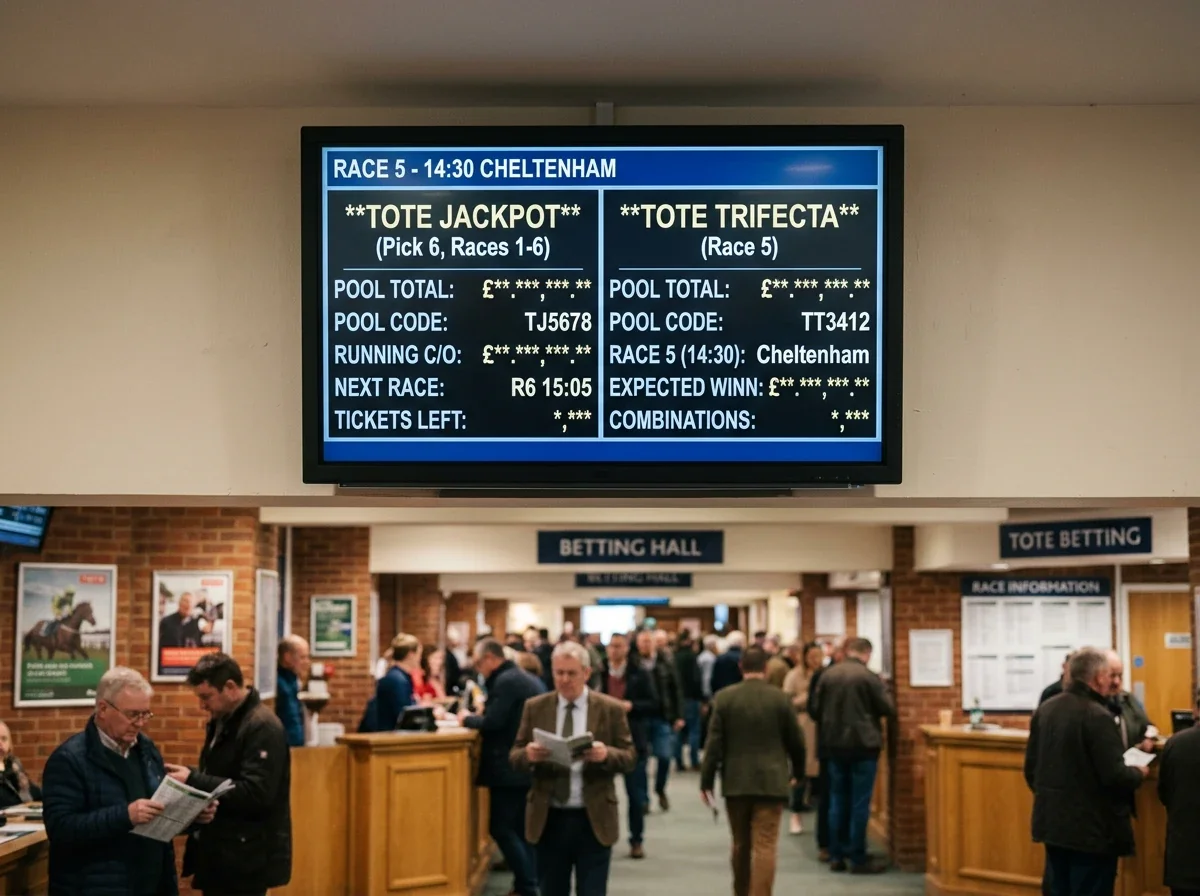
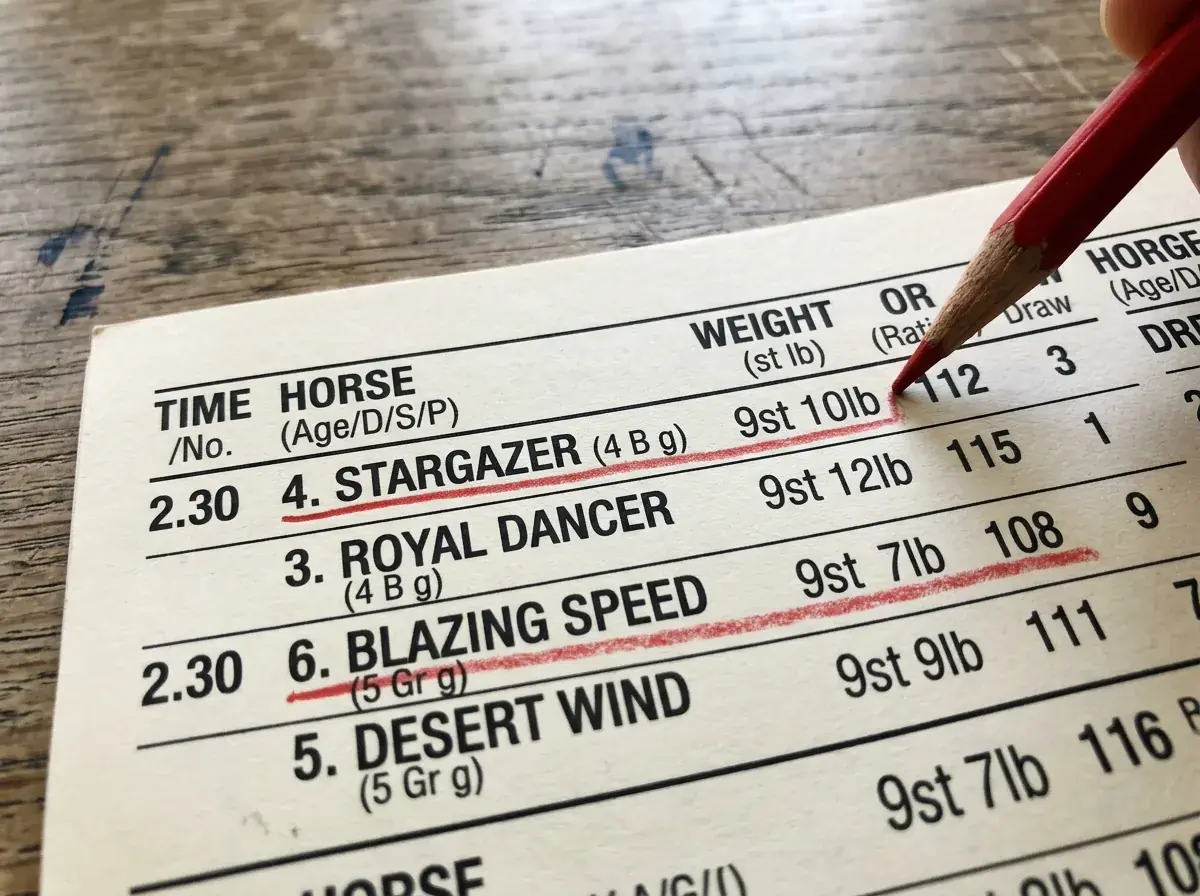
I have a habit at the kitchen table on a Saturday morning that probably looks neurotic from the outside. I go through the racecard with a pencil before I even open a betting app. Five minutes per meeting, ticking which races merit a box and which don’t. Twelve years of doing this, and the pattern is consistent: about one race in four on a Premier card is worth a box bet, the other three are not. The slip you place is downstream of the race you pick. If the race is wrong, no amount of clever boxing fixes it.
This is the lesson most box-bet guides skip. They start with “how to perm five horses” and end with “place your bet”. They never tell you the harder question, which is: should you be perming anything on this race in the first place? A six-runner Group 1 with two market principals at 6/4 and 7/4 is a different beast from a fourteen-runner Class 2 handicap with the favourite at 4/1 and seven horses inside 10/1. You don’t approach both the same way, and the difference is the entire point of race selection.
What follows is the screening process I run before the slip ever sees a horse name. Field size, race code, market shape, weight signals, going, trip, and the late market formation that the BHA’s punctuality push has subtly altered. None of these criteria is exotic. All of them are checkable from any decent racecard. The discipline is to actually check them — every race, every time — before deciding the box is the right product.
When analyzing field sizes and weights, you must know how to interpret an official rating vs handicap mark to spot well-treated horses.
Field size is the variable that decides everything else
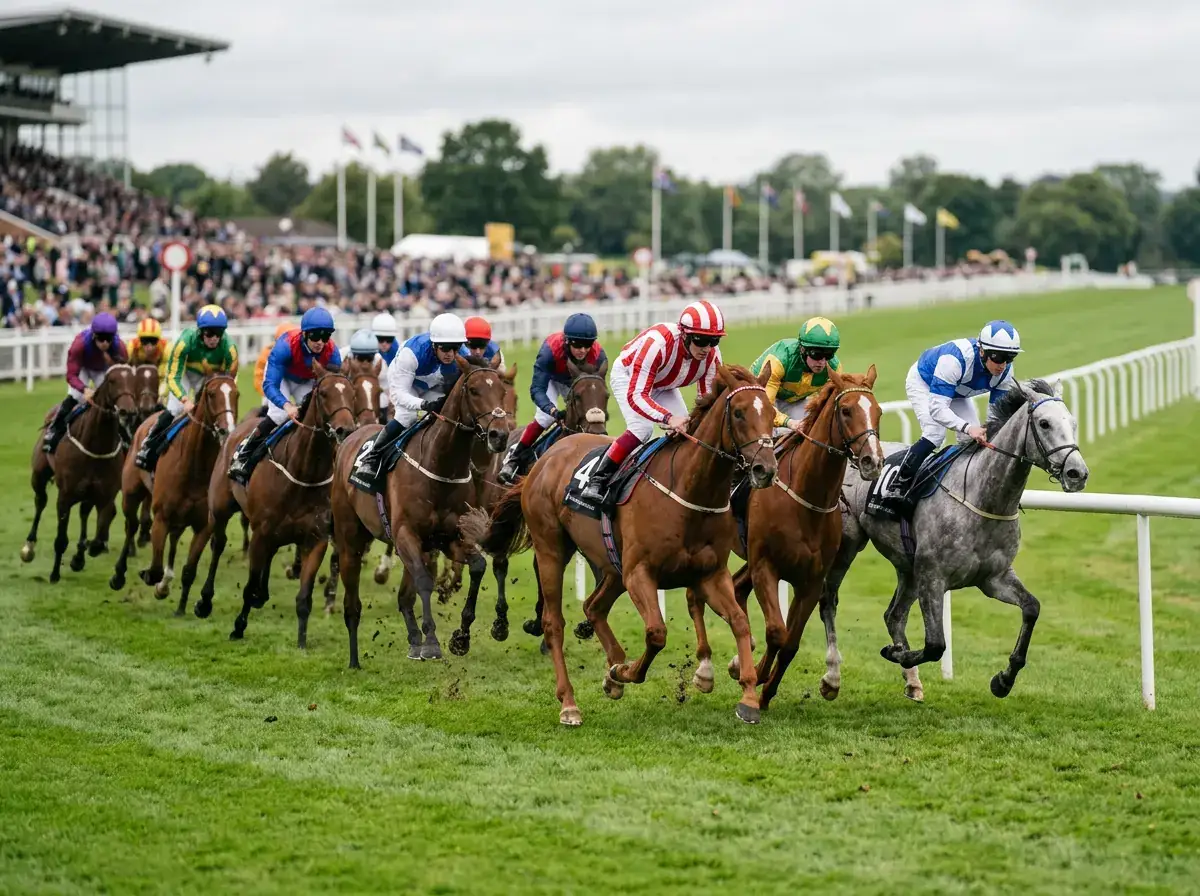
The first number on the racecard I look at is the number of declared runners. Everything else flows from this. A small field — six or fewer — produces concentrated markets, short prices on the favoured pair, and a structural problem for any combination bet: there aren’t enough realistic permutations to make the perm earn its outlay. A large field — twelve or more — produces dispersed markets, multiple contenders on similar marks, and the precise conditions in which boxing makes mathematical sense.
BHA Q3 2025 data gives the baseline. Average runners per race at Premier Flat meetings sat at 11.02. Premier Jumps came in at 9.41. Core Flat — the workaday weekday card at Wolverhampton, Lingfield, Southwell — averaged 8.54. Those numbers tell you immediately where the box bet’s natural habitat lives. Premier Flat is the sweet spot: eleven runners on average means most races have eight to fourteen runners declared, with enough genuine contenders to perm and enough field depth to produce competitive markets.
Below seven runners, the box bet is structurally compromised. Not because it can’t win — it can — but because the market has already done your work for you. With six runners declared, the favourite typically goes off at 6/4 or shorter, the second favourite at 3/1 or 7/2, and the rest of the field at 8/1 and bigger. The combination of “first two in either order” is already heavily backed at short prices; the CSF dividend on that combination will be modest, the Tote pool will be diluted by many winning tickets, and the slip’s value-for-stake is thin. The market has already priced in your read.
Above sixteen runners, you face the opposite problem. Too many genuine contenders, too many permutations needed to cover them, outlay grows faster than the dividend can compensate. A sixteen-runner handicap might genuinely have eight or nine horses you can defend as having a chance — boxing all of them on a tricast gives you 16 × 15 × 14 = 3,360 lines, which at any sensible line stake produces a stake that no rational punter should commit to a single race.
The window is eight to fourteen runners declared. That window covers the bulk of Premier Flat handicaps, most jumps handicaps at Festival meetings, and a fair slice of midweek Class 3 and 4 contests at the better mainland tracks. Inside that window, the box bet has both the field depth to justify perming and the price dispersion to produce returns commensurate with the outlay.
One subtlety. The Q3 2025 BHA figures also showed punctuality up to 87.6% of races starting within two minutes of advertised time — a sharp rise from 79.2% in 2024 and 72.7% in 2023. That punctuality directly affects field size dynamics, because tighter starting protocols mean fewer late withdrawals and a more stable closing market. The race you see in the morning paper is closer to the race that actually runs than it was three years ago, which is good news for anyone who wants to plan a slip the night before. I’ll come back to the punctuality point later because it has a non-obvious knock-on effect on late market formation.
Race code matters more than punters think
Not every race type is built equally for boxing. The honest hierarchy looks like this, from most box-friendly to least: contested handicaps first, then competitive conditions stakes, then competitive Listed races, then large-field maidens, then Group races, then small-field Listed and Group races at the bottom of the box-bet stack.
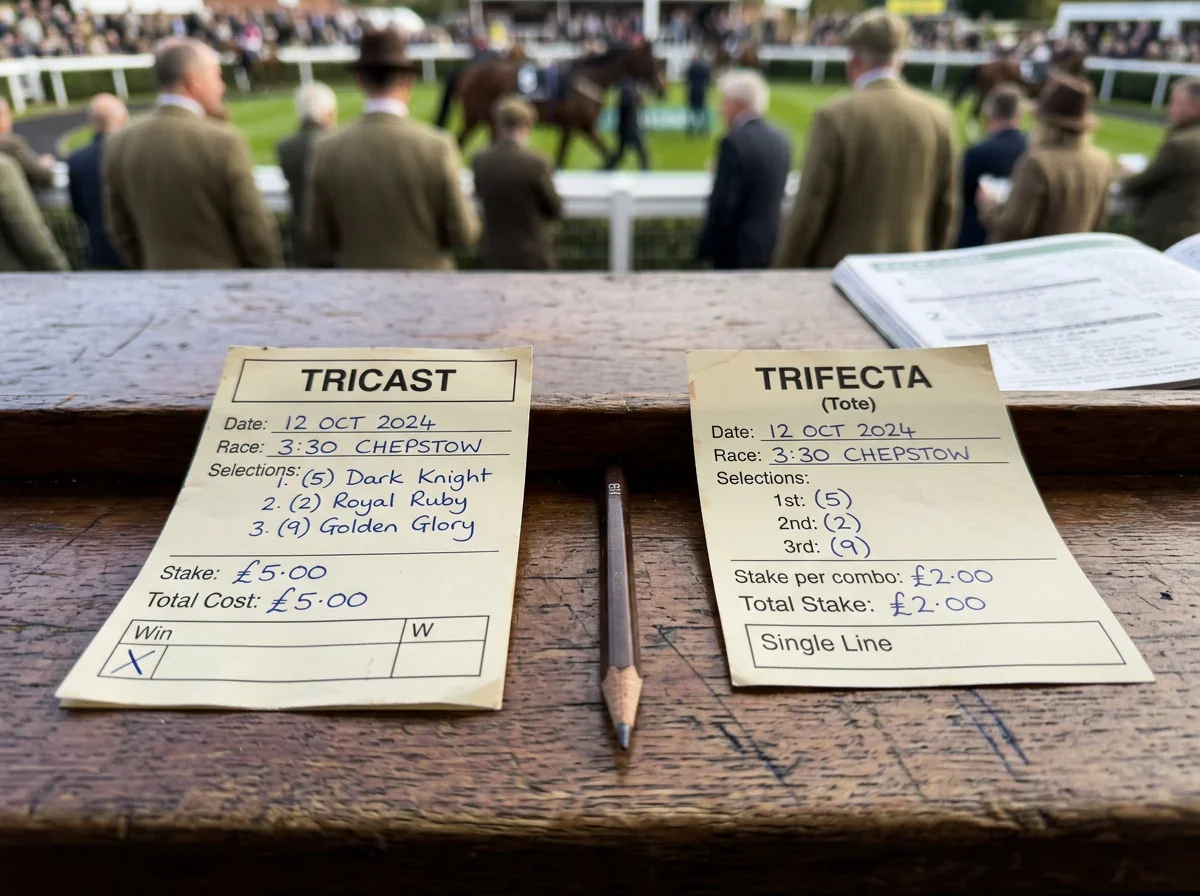
Contested handicaps are the natural home. The whole structural premise of a handicap is to equalise the field — the official handicapper allocates weights to bring horses to a theoretically common winning chance. The result is competitive markets, dispersed prices, multiple plausible winners, and exactly the conditions a combination forecast or tricast was built for. The 8+ runners rule that gates tricast availability is a structural acknowledgement of this: a tricast on a fewer-runner field is so likely to short-price the top three that bookmakers don’t bother quoting one.
Competitive conditions and Listed races sit just below handicaps in box appeal. Conditions races have weight-for-age and penalty structures rather than handicapper-equalised marks, so the better horse genuinely has more chance than the lesser horse — but in a fifteen-runner conditions race, you still get enough field depth to perm a defensible shortlist. Where conditions races diverge from handicaps is the dispersion of prices: market principals tend to be shorter, the tail tends to be longer.
Maidens are unusual. A twelve-runner two-year-old maiden is one of the few non-handicap races where boxing is structurally defensible, because the form lines are sparse — many runners have one or two career starts at most — and the market is uncertain about who the genuine contenders are. The catch is that the favourites’ strike rate in maidens is high; if you box too widely you are paying for permutations involving unraced or lightly-raced horses with little chance.
Group races, particularly small-field Group 1 and Group 2 contests, are where boxing breaks down. A six-runner King George at Ascot, with two market principals shorter than even-money on the win bet, gives you nothing to perm. The favourite-second favourite combination is the heavily-backed line, the dividends are tiny, the Tote pool is shallow, and the slip’s expected value is poor. Save your boxing for Group races with twelve-plus runners — the Eclipse with a competitive field, a Champion Stakes with a wide-open look — and bypass the contests that have effectively become two-horse races by the off.
Favourites win 33% of UK flat races. Build the slip around that.
The single most useful number for race selection is the favourites’ strike rate. UK industry data — drawing from Grand National Fans and major aggregator sites — shows favourites winning 30% to 35% of races across all UK racing. The breakdown matters: flat racing favourites strike at around 33%, jumps novice race favourites at around 33%, and jumps handicap favourites at only 27%. That last number is the one that should drive most of your box-bet thinking.
Think about what 27% means in practice. In a competitive jumps handicap — the type of race that constitutes the bulk of National Hunt racing through autumn and winter — the favourite wins fewer than three races in ten. That implies the favourite loses seven times in ten. Of those seven losses, the favourite often finishes in the top three but not first. So a box bet that includes the favourite, plus two or three other plausible winners, is making a structural bet that captures the favourite’s full distribution: 27% of the time the favourite wins, but the other 73% of the time you still have multiple horses on the slip that could fill the top spots without the favourite.
This is the “perm the favourite plus three” logic that experienced jumps punters apply. You include the favourite because they win 27% of the time and often place when they don’t win. You include three or four other contenders because in the 73% of races where the favourite doesn’t win, another horse on similar form or with a more genuine staying chance often does. The slip’s expected value across the full distribution of outcomes is positive in a way that a single straight bet on the favourite cannot be.
On the flat, the 33% favourites strike rate works slightly differently. Flat races, particularly conditions and Group races, tend to be more “best horse wins” — the favourite’s higher win rate reflects genuinely superior form rather than the handicapper’s equalisation. So the box-the-favourite-plus-three logic applies less cleanly to flat conditions races; you’re better off boxing among the genuine contenders rather than always insisting the favourite be on the slip. In flat handicaps, the same 33% strike rate produces the same logic as jumps handicaps: include the favourite, include three or four other plausible contenders, let the dispersion of outcomes work for you.
The trap is the four-runner conditions race with the 4/6 favourite. The 33% strike rate doesn’t apply there — short-priced favourites in small fields win at much higher rates than the aggregate, often 50% or more. Boxing the favourite plus two outsiders in that scenario is paying for permutations that mostly involve the favourite losing, which is a low-probability event for which the dividend on the unusual combination isn’t compensating. Race selection means recognising those races and walking past them.
Reading weights: the official rating and the penalty signal
There’s a moment in every handicap card where I find myself doing the same little arithmetic — the kind that anyone who has spent five years studying the form does without thinking. Look at the OR. Look at the weight allocated. Look at the gap between yesterday’s published rating and what the handicapper has dropped the horse to for today. That gap is information, and it tells you more about a slip than any tip sheet ever will.
The official rating is the handicapper’s published opinion of how good each horse is, expressed as a number in pounds. A horse rated 80 is theoretically four pounds better than a horse rated 76, and the handicap weights are allocated to reflect that — the rated-80 horse carries four pounds more on the racecard. In theory, on the day, both horses have an equal winning chance after the weight equalisation.
In practice, the OR has signal value that goes beyond pure weight equalisation. Steve Lewis Hamilton, the professional punter, has been quoted noting that “the handicap rating given to any horse is somebody’s opinion. Granted, it is based upon evidence, but nonetheless it is the official handicapper who allocates a horse their BHA rating.” That qualification matters. The handicapper is reactive — ratings adjust after results — and the punter’s edge is in spotting horses whose current form has not yet been reflected in the official mark.
Race Advisor analysed over 400,000 individual runners across UK racing and found that horses with an Official Rating ten or more pounds higher than their assigned mark for today’s race consistently produced the strongest results in their field. The mechanism is straightforward: if a horse’s published OR is 10+ pounds above what the handicapper has set them to carry today — typically because of an apprentice claim, a weight-for-age allowance, or a transition between handicap categories — that horse is structurally favoured before the race even begins. Boxing slips should pay attention to this. A horse running at a usable “ratings-mark gap” is more likely to be on the right side of the top-three split than its market price implies.
The opposite signal is the penalty. Horses carrying a 5-7 pound penalty for a recent win — the standard penalty applied between a winning performance and the handicapper’s next reassessment — produce a curious data profile. Geegeez analysis of UK racing data going back to 2008 shows penalised horses winning at a strike rate of 23.47% — actually higher than average — but generating a return on investment of −15% because the market compresses their price to reflect both the recent win and the penalty’s apparent severity. The market over-corrects.
For the box-bet punter, that ROI gap is meaningful. A penalised horse on your slip is statistically more likely to win than the average horse, but you are paying more for that win in the form of a shorter price. Including penalised horses in your perm is defensible when their price is genuinely longer than the market average — say, an 8/1 penalised horse in a field where they would normally go off at 5/1 absent the penalty — but it is not automatic. The penalty is information; whether you act on it depends on whether the price has fully absorbed it.
For the deep-dive on how official ratings interact with handicap marks in practice, including the table of which OR-mark gaps produce the strongest historical edges, the standalone piece on official rating versus handicap mark gaps is the granular reference. For race selection, the working rule is: prioritise races where the OR-mark gap signal is meaningful, and discount races where the market has already priced the gap away.
Going and trip: the noise variables that decide variance
The state of the ground and the distance of the race are the two variables most likely to widen the gap between favourite and outsider — and therefore most likely to make a box-bet slip more or less valuable. Soft and heavy going produce upsets. Yielding and good-to-soft going produce mixed results that don’t quite resemble form on firmer ground. Good and firm going tend to produce form-line results where the better-rated horses prevail.
The slipped-up trip — a horse running well outside their typical distance preference, either too far or not far enough — is the other noise variable. A horse that has shown its form at 7 furlongs but is dropping to 5 furlongs is a different proposition; same horse, different distribution of expected outcomes. The market knows this and prices it in, but the market’s pricing is an average, and on race day the conditions either confirm or reject that average.
For box-bet purposes, the framing is: do the conditions favour form-line outcomes, or do they favour upsets? If form-line, the favoured horses are more likely to fill the top three, and a tighter shortlist of three or four covers the likely combinations well. If upset-friendly — soft ground, awkward trips, first-time-on-the-distance runners — the field opens up, more horses become plausible top-three finishers, and the slip should widen to four or five names with the line stake adjusted down to keep the outlay sensible.
The mistake I see is boxing without recognising which scenario you’re in. Punters who’d happily box four horses on good ground will box the same four horses on heavy ground without reweighting their shortlist — and miss the long-priced winner that wouldn’t have been in the frame on faster ground. The slip should adapt to the going, not just to the form lines.
Discover the most profitable wagering angles directly at Permline.
Punctuality and late market formation: the BHA effect
Here is a piece of the puzzle that did not exist three years ago. UK racing’s punctuality, the proportion of races starting within two minutes of advertised time, climbed from 72.7% in 2023 to 79.2% in 2024 to 87.6% in Q1 2025. That is a major structural shift in how races run, and it has a non-obvious effect on the late market.
The connection works like this. When races start late — and three years ago, more than a quarter of them did — the late betting market continues to form right up to the off, with prices fluctuating as on-course volumes come in. Late market moves capture sharp money in a way pre-off morning prices do not. With races now starting on time over 87% of the time, the window for late market formation is compressed. The closing market — the prices in the last two or three minutes — tends to be tighter, more accurate, and less skewed by late information.
For the box-bet punter, this is good news and a constraint. The good news is that the closing market is a more reliable signal of true probability than it used to be — the favoured horses are more accurately favoured, the longer-priced horses are more accurately priced. The constraint is that the late shopping window for value has narrowed. The “race delayed, market shifts, contrarian play opens up” pattern that some punters relied on has thinned considerably. If you are going to make race-selection calls based on late market signals, you have fewer signals to work with than you did pre-2024.
The practical implication is that the slip you write the night before is closer to the slip that should actually run on the day than was true three years ago. Field sizes are firmer, late withdrawals are scarcer relative to total volume, the off-time market is closer to the closing market. The discipline of pre-race screening rewards the punter who actually does it; the punter who waits for late-market signals has less to wait on.
A worked example: twelve-runner Class 3 handicap, autumn turf
Let me ground all of this in one race. Twelve-runner Class 3 handicap, mile and a quarter on good-to-soft ground at Pontefract in late September. Favourite at 5/1, three more horses at 13/2 or shorter, the rest of the field at 8/1 and bigger. Top weight is a 9-year-old gelding rated 84, dropping in weight after running well over 7f at York three weeks ago.
The race-selection screen passes cleanly. Field size of twelve sits in the sweet spot. Class 3 handicap is the natural home for boxing. Good-to-soft ground tilts slightly toward form-line results but not enough to compress the field below the box-bet threshold. Favourites strike at 33% on flat and 27% in jumps handicaps — the 5/1 favourite here is no banker, leaving room for two or three horses on similar marks to defend a top-three finish.
The shortlist takes shape. The 5/1 favourite, in form and well-handicapped after a recent runner-up. The 13/2 second-favourite, dropping back in trip from a poor effort at Doncaster. A 7/1 horse rated 76, carrying a 5-pound penalty for a win at Beverley two weeks ago — the penalty figure adds a layer of caution given the market’s 23.47% strike but −15% ROI on penalised runners. And a 9/1 horse with a meaningful OR-mark gap, rated 78 but apprentice-claiming on a forgiving track configuration.
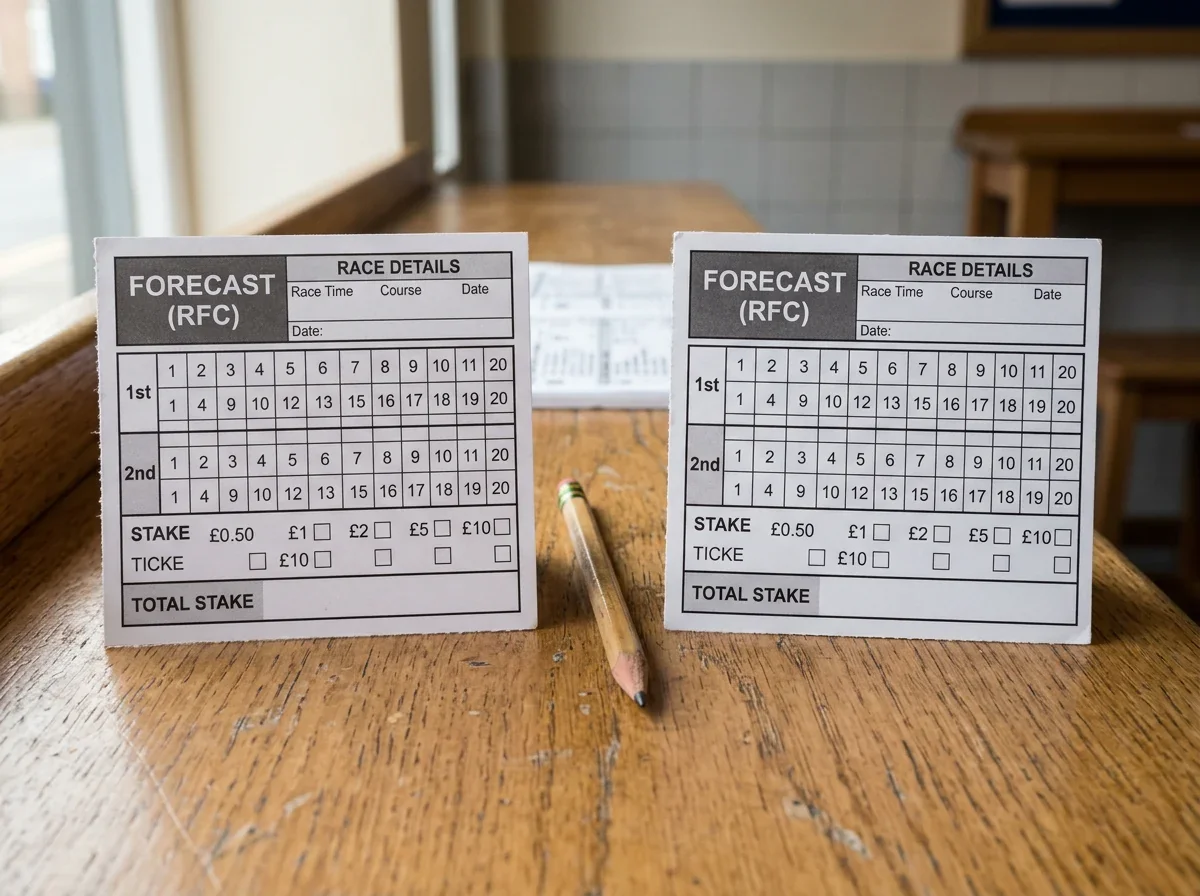
That’s four horses. A combination forecast at £1 line stake costs £12. A combination tricast at £1 line stake costs £24. The choice between products comes down to your read on the third-place dynamic. If you genuinely believe a fourth contender could pinch third — the wider tail of the field has multiple horses inside 10/1 — the tricast captures a 1-2-3 that includes more upset potential. If you think the top three are likely from your shortlist, the forecast is the cleaner cost-to-outcome ratio.
What I would not do is widen to six horses. The penalty-carrying 7/1 horse and the OR-gap 9/1 horse are already at the margin of “real contender”. Adding a fifth and sixth name would mean perming horses I don’t quite believe in, paying for permutations involving names I wouldn’t back individually. The cost discipline collapses past five selections on most twelve-runner handicaps, and the working rule holds: if you can’t say “yes, this is a genuine top-three candidate” about the fifth name on the slip, that name doesn’t belong.
The race picks the slip, not the other way round
Every productive conversation I’ve had about box bets eventually returns to this. The slip is downstream. The race is upstream. The discipline is to screen the race against criteria — field size, race code, market shape, weight signals, going, trip — before deciding the box is the right product, and then to size the slip against the shape of the race rather than the shape of your bankroll.
The BHA data I’ve leaned on through this piece — 11.02 average runners on Premier Flat, 27% favourites strike in jumps handicaps, 23.47% strike but −15% ROI on penalised runners, 87.6% on-time starts — is not garnish. It is the structural baseline against which any individual race must be screened. A race that doesn’t pass the screen doesn’t get a box bet, regardless of how appealing the names on the card look or how flush the bankroll feels.
And one practical close. Once you’ve done the screen and the race passes, sit with the shortlist for sixty seconds before committing the slip. Ask yourself, name by name: would I back this horse to win, on its own, at the current price? If the honest answer is no on any name, that name comes off the slip. Boxing is not a way to back horses you wouldn’t back individually. It is a way to cover the uncertainty about which of several genuine contenders will fill the top slots. The boundary between those two ideas is where most of the money in box-betting either gets made or quietly lost.
Wait, in most cases. Seven runners is below the box-bet sweet spot. With seven declared, the favourite typically goes off at 6/4 or shorter, the second favourite at around 3/1 or 7/2, and the rest at 8/1 plus — meaning the heavily-backed forecast or tricast combinations are short-priced and the dividends are thin. Exceptions exist for unusually competitive seven-runner contests where the market is genuinely uncertain across four or five horses, but those are rare. The structural rule of thumb is eight to fourteen declared runners; below eight, look to single-bet or place-bet plays rather than a perm. Not on its own. A 33% strike rate means the favourite wins one race in three, which is materially better than any other horse in the average field — but it also means the favourite loses two races in three, and in many of those losses the favourite still finishes second or third. The structural logic is to include the favourite on the slip alongside three or four other genuine contenders. Boxing horses around the favourite — without including the favourite — only makes sense in races where the market has clearly mispriced the favourite, which is uncommon. Yes, but the effect is double-edged. Penalised horses — carrying 5-7 extra pounds for a recent win, before the handicapper reassesses — win at a strike rate of 23.47% according to long-run UK racing data, which is above field average. But their ROI is −15% because the market overcorrects, compressing their price to reflect both the recent win and the penalty’s apparent severity. Including a penalised horse on a box slip is defensible when their price is genuinely longer than the market average for that strike rate would suggest, and discountable when the market has fully priced in the recent form.Should I box a 7-runner race or wait for a bigger field?
Does favourites’ 33% UK flat strike rate justify boxing them out?
Does a horse’s recent win penalty change the box-bet decision?
Published by the box bet in Horse Racing team.