
Official Rating vs Handicap Mark: Selecting Profitable Box Bets
 Available in US
Table of Contents
Translating the Official Rating into Assigned Weight
“The handicap rating given to any horse is somebody’s opinion. Granted, it is based upon evidence, but nonetheless it is the official handicapper who allocates a horse their BHA rating.” That’s Steve Lewis Hamilton – a professional punter whose work I’ve followed for years – and the sentence captures exactly why so many casual boxing punters get the OR wrong. They treat it as a fact about the horse. It isn’t. It’s an opinion. And like every opinion, it’s right most of the time and wrong some of the time, with the wrong-some-of-the-time cases being where most boxing edges actually live.
The Official Rating – the BHA mark assigned to every horse in handicap company – is the first piece of information I look at when shortlisting selections for a combination forecast or tricast. It’s also the single piece of information most reliably misread by casual punters, who either ignore it entirely or treat it as gospel. Both extremes lose money. The right approach sits in the middle, and this article is about getting there.
Where the OR comes from – the handicapper’s view
The OR is set by the BHA handicapper for that horse’s discipline – there are separate handicappers for Flat, jumps, and increasingly fine subdivisions within each. The mark reflects the handicapper’s assessment of the horse’s ability based on its racing record: where it’s run, who it’s beaten, what weights those rivals have carried, the margins of victory and defeat, and contextual factors like ground and trip preferences.
The mark moves after every race. A horse that wins by three lengths off 75 will typically rise to 80 or 81 next time out, depending on the form of the horses behind. A horse that finishes seventh of fifteen off the same mark will likely stay at 75 or drift down by a pound. The mark adjustments happen weekly, published on the BHA’s official channels, and become live for races run after a specified date.
What the OR doesn’t capture is what the handicapper hasn’t seen yet. A horse that’s been gelded since last running, a horse that’s switched stables, a horse that’s been working out brilliantly on the gallops but hasn’t yet expressed that form in a race – none of this shows in the OR. The horse runs off its old mark while its actual ability has changed. Those gaps are where the boxing punter’s edge lives, but reading the OR correctly is the foundation that lets you spot them.
The OR versus today’s assigned weight – the gap most casual punters miss
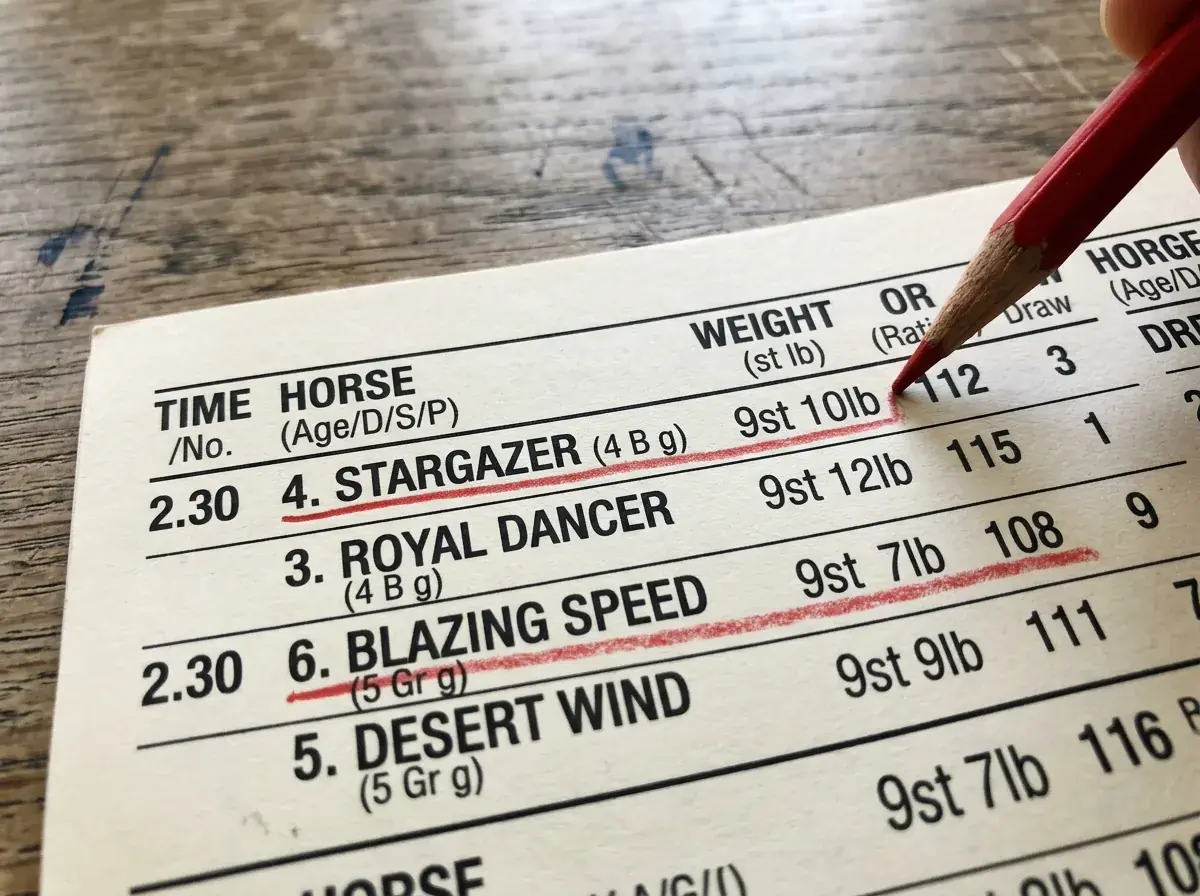
The OR is the mark the handicapper has assigned to the horse. Today’s assigned weight is what the horse will actually carry in this specific race. The two numbers are linked but not identical, and the gap between them is informative.
In an open handicap, today’s weight is calculated from the OR using the race’s weight structure – top weight 9st 7lb, weight-for-rating from there. A horse rated 75 in a race where 84 is top weight off 9st 7lb will carry around 9st 0lb. The gap is mechanical. But in handicaps with penalties (5 to 7 pounds added for a recent win, awaiting reassessment by the handicapper), today’s weight can be 5 or 7 pounds above what the OR alone would suggest.
Race Advisor’s research across more than 400,000 runners found that horses with an Official Rating 10 or more pounds higher than the mark they’re carrying today consistently show the strongest performance figures within a field. Read that carefully. The horse rated 85 carrying weight for a mark of 75 – because of a race condition, a handicap class, or some structural feature of the race – outperforms the field on average. The OR is the signal; the assigned weight is the opportunity.
The penalty effect – short-term price compression that misleads casual money
The geegeez.co.uk UK racing data from 2008 to 2025 shows something specific about penalty-carrying horses. They win at a strike rate of 23.47%, which sounds promising. The ROI sits at -15%, which doesn’t.
The mechanism is market compression. A horse that won last time out and is now carrying a 5 to 7 pound penalty looks short in the market because the recent win is fresh. The casual money piles in. The price compresses below where the underlying probability sits. The horse still wins more often than not by raw strike rate, but the price the punter has to take in the market doesn’t reward the win frequency. Long-run, betting penalty horses to win loses money even though they win at a respectable rate.
For boxing purposes, this matters in two ways. First, penalty horses are unreliable inclusions at the top of a combination forecast shortlist – the market has them too short, and the dividend on a forecast that includes them tends to disappoint. Second, penalty horses are often more useful as “second-string” inclusions further down a box trifecta or superfecta shortlist, where their hit-rate value plays into the perm without the short-price penalty distorting the dividend on the whole bet.
How I use the OR in actual perm construction
The construction logic I run starts with the OR distribution of the field. In a typical 12-runner handicap, I’d expect ORs spread across 15 to 25 pounds – the top weight maybe rated 88, the bottom weight rated 67 to 70. The horses to focus on first are those with ORs in the upper half of the spread who are also carrying weight for ORs near their actual mark (no significant gap between OR and today’s assigned weight, ruling out the 10-pound gift signal Race Advisor identified).
From that filtered group, I’d then layer in penalty horses cautiously – they go into the perm only if the dividend mathematics still work after accounting for their compressed market price. A penalty horse at 6/4 in a contested handicap is rarely worth including in a forecast shortlist; the same penalty horse at 4/1 might be, if the rest of the perm is built around longer-priced contenders.
The +10lb signal is the cleanest structural edge available from OR analysis. Premier Flat meetings averaged 11.02 runners per race in BHA’s Q3 2025 reporting period, Premier Jumps 9.41, Core Flat 8.54. Across that spread of field sizes, identifying the horse with the strongest OR-versus-assigned-weight gap in a contested handicap is one of the most reliable ways to anchor a perm – and the boxing approach lets you back that horse to finish in any of the placed positions rather than committing to a specific finish.
For the broader race-selection logic that builds on top of OR analysis, the guide to reading UK fields like a professional covers the field-size and going factors that complement the OR analysis described here.
Why can a horse rated 10 pounds higher today still drift in the market?
The OR signals raw ability but not current form, fitness, suitability for the going, or the punter’s collective view of the horse’s recent training. A horse rated 10 pounds above its assigned weight can still drift if the public has seen reasons to doubt it from the racecard or trade press – and sometimes the drift is wrong, which is where the OR-based edge becomes profitable.
Should I always exclude penalty-carrying horses from my box?
Not always – but treat them with caution. The -15% long-run ROI on penalty horses comes from systematic over-backing by the public. Including a penalty horse as a second or third-string selection in a box trifecta can work when the price is large enough to compensate; including one as the top selection or in a forecast pair more often punishes the perm than rewards it.
Published by the box bet in Horse Racing team.