Each-Way vs Forecast: Two Different Bets That Look the Same on the Card
 Available in US
Table of Contents

Two products, two completely different jobs on the same handicap
An old punter at my local used to say each-way was for backing horses to place and the forecast was for backing horses to place u2014 the same outcome through different products. He was almost right and importantly wrong. The each-way bet and the forecast cover overlapping ground on the racecard, but they’re structurally different products with different settlement mechanics, different expected-value profiles, and different risk shapes. Knowing which to use in which situation is the difference between a punter who deploys exotics with discipline and one who treats them interchangeably.
The two products share a surface similarity. Both involve a horse running near the front of the field without necessarily winning. Both pay out on placed finishes. Both can be combined with multiple selections through different staking structures. But the structural mechanics underneath those surface similarities are different enough that the right product on a specific race depends on a specific question: do you have a single horse you’re confident will place, or do you have a pair of horses you think will fill the first two positions in some order?
What an each-way bet actually does
An each-way bet is two stakes u2014 one on the horse to win, one on the horse to place. A £5 each-way bet is therefore £10 total: £5 on the win, £5 on the place. If the horse wins, both the win and place legs pay out. If the horse only places, only the place leg pays out. If the horse finishes outside the placed positions, both legs lose.
The place portion of the each-way bet pays at a fraction of the win price, typically 1/4 or 1/5 depending on the race conditions. The number of places that count varies with field size: 2 places in a 5 to 7-runner race, 3 places in an 8 to 15-runner handicap, 4 places in a 16+ runner handicap (4 in some operators, 5 in others, depending on race type). The structural appeal is that the each-way bet wins more often than the win bet alone, at the cost of the place portion’s reduced odds.
Each-way is the most familiar exotic to UK casual punters. With 24.4 million active accounts at UK operators by the end of the last reported quarter, the each-way market is one of the highest-volume product categories on UK racing, dwarfing forecast and tricast volume. The market saturation also means each-way pricing is sharper than forecast pricing u2014 bookmakers know the each-way customer base intimately and price the product accordingly.
The forecast difference u2014 two horses, ordered pair
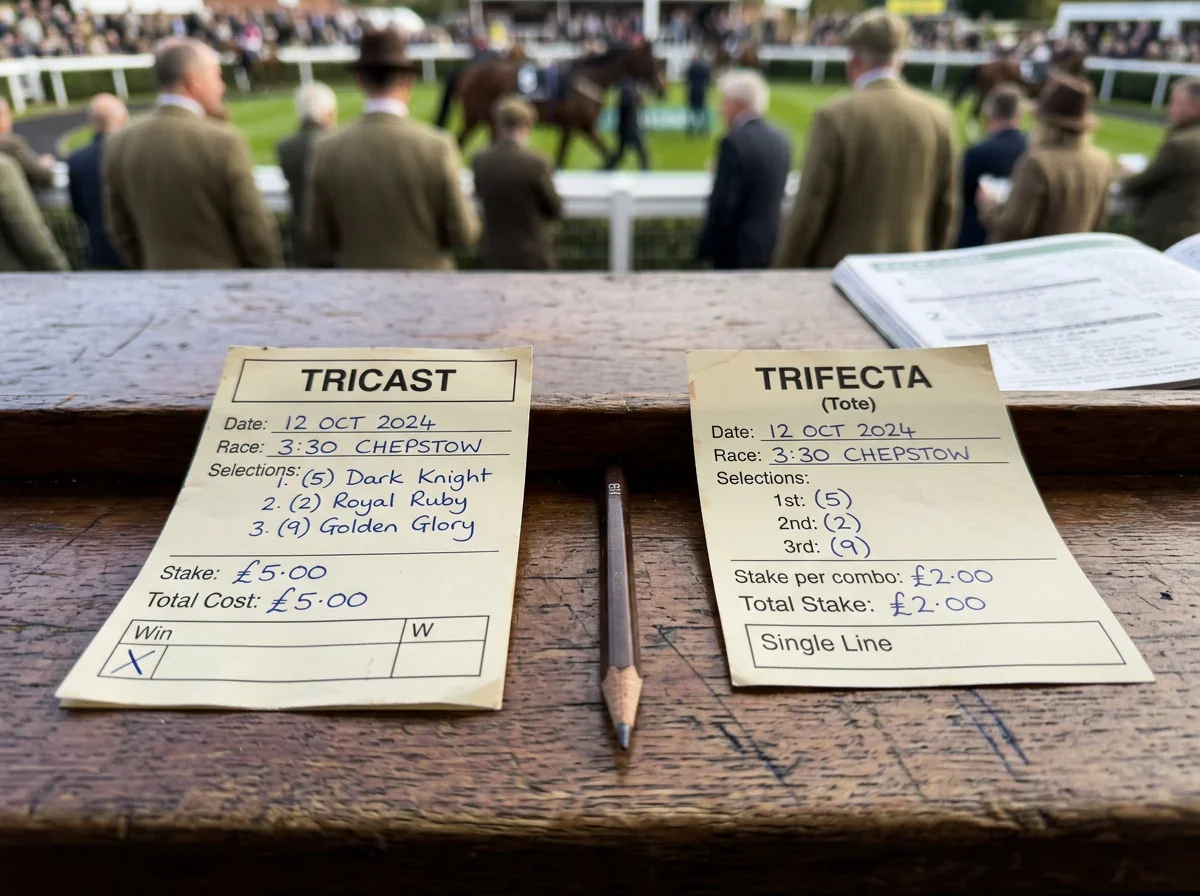
The forecast is a fundamentally different bet. It picks two specific horses to finish first and second, in either a specific order (straight forecast) or any order (reverse or combination forecast). The bet wins only if those two horses fill the first two positions. The bet loses regardless of whether either or both horses placed third or fourth u2014 placing isn’t relevant to forecast settlement.
The structural appeal of the forecast over the each-way is the dividend size. A forecast on two horses producing the correct 1-2 result delivers a CSF dividend that’s typically 5 to 15 times the each-way return on either horse individually. A £5 reverse forecast on two horses that go off 4/1 and 8/1 might cost £10 and return a £100 CSF dividend if the pair fills the first two positions. The same £10 invested in each-way on the same two horses would return at most twice the win portion plus twice the place portion u2014 typically £40 to £60 in a similar handicap.
The trade-off is hit rate. The forecast wins less often than the each-way because it requires a specific pair structure rather than any-placed-finish. For a 14-runner handicap where the public has identified four genuine contenders, the each-way bet on the favourite hits roughly 35-40% of the time (the favourite places in about that proportion of contested handicaps), while the forecast on any specific pair hits roughly 5-10%.
When each-way is structurally better than the forecast
The each-way is the right product when the punter has identified a single horse with strong placing chances but moderate winning probability. The classic case is a 14/1 or 16/1 horse in a 12-runner handicap whose form figures suggest consistent placing without often winning outright. An each-way bet on that horse captures the high probability that the horse places without overcommitting to the win.
Each-way also wins on bankroll-management grounds for punters who want frequent small returns. Place finishes from 6/1 to 16/1 horses are common enough that each-way returns multiple small wins across a typical Saturday, smoothing the bankroll’s volatility. For a £30 weekly budget, three £10 each-way bets across a card produces a less volatile P&L curve than the same £30 deployed as forecast perms, with the trade-off being smaller upside on big-result days.
The Lee Phelps quote from William Hill before the 2026 Cheltenham Festival u2014 projecting around £450 million wagered across the four days and calling the Festival “unrivalled in Jumps racing” u2014 captures the kind of betting volume that’s split between each-way and exotic products in particular weighting on Festival days. Each-way bets on the contested handicaps are where the bulk of Festival recreational volume sits, with forecast and tricast bets capturing the more aggressive end of the market.
When the forecast structurally wins
The forecast is the right product when the punter has identified two specific horses they think will fill the placings ahead of the rest of the field. A 5/1 favourite and a 9/1 second-favourite on a contested handicap, where the punter genuinely believes those two will run 1-2 against the wider field, is the textbook forecast situation. The reverse forecast captures the placings without requiring a view on the order.
The dividend size is the structural advantage. A successful reverse forecast at £2 (two £1 lines, one of which wins) on a 5/1 and 9/1 pair will typically pay £40 to £70 in CSF dividend, against an each-way return at maximum of £20 to £30 on either horse alone. The forecast wins less often but pays substantially more per win, which over a long sample produces stronger ROI for punters who can reliably identify placing pairs.
The forecast also benefits from the Tote+ structural advantage. Tote+ Exacta beats the CSF in 77% of cases with an average +21% value per bet. That’s a structural uplift the each-way bet doesn’t have access to u2014 each-way settlement is at fixed fractional odds with no parimutuel guarantee mechanism. The forecast punter who routes through Tote+ collects 21% more on average per winning slip than the CSF-only punter, an edge that doesn’t exist on the each-way side of the comparison.
Pairing the two products in a balanced staking plan
The most effective stake distribution I’ve seen across a Saturday is one that pairs each-way and forecast bets across complementary races. The each-way bets cover the races where you have a single-horse conviction and want consistent returns. The forecast bets cover the races where you’ve identified a placing pair and want the dividend upside.
A £30 Saturday budget might break down as £12 each-way (two £6 each-way bets on different races, total £12) plus £18 in a single combination forecast on four horses at a contested handicap (12 lines at £1.50, rounding to a 50p unit at £6 outlay on 12 lines, leaving £12 still in the each-way bucket but the budget reallocating). The exact split depends on race availability, but the principle is to use each product where its structural advantage is greatest.
The discipline that makes the pairing work is recognising in advance which product fits the race. A handicap with one strong placing prospect at 12/1 and a weak top of the market is an each-way race u2014 the forecast structure isn’t there. A handicap with two genuine contenders at 5/1 and 7/1 and a wider competitive field is a forecast race u2014 the each-way on either alone leaves placing-pair value uncollected. The full logic of how to choose products by race profile sits alongside the broader race-selection guidance in the field-reading discussion, where the structural variables that determine product choice are laid out.
Can I bet a combination forecast and each-way on the same race?
Yes, and many serious punters do exactly that when both signals are present. An each-way bet on the strongest single placing prospect alongside a combination forecast covering the placing pair captures both the high-probability single-horse outcome and the lower-probability pair outcome. The two bets settle independently, so winning on either or both delivers the relevant returns.
Why does each-way pay a fraction of the win price instead of full place odds?
The fractional payout (typically 1/4 or 1/5 depending on race type and field size) reflects the higher probability of placing versus winning. Full place-odds payouts would create negative expected value for the bookmaker because placing is structurally more likely than winning. The fractional structure balances the higher hit rate against the lower per-unit return.
Created by the ”box bet in Horse Racing” editorial team.